


Czech technology company FLOWBOX, which develops energy management software, has been listed in eight Hype Cycle reports published this year by US analyst firm Gartner, spanning manufacturing and energy, microgrids, data centers and smart cities. In 2024, the company appeared in one report; last year, in three. FLOWBOX is also the only company from Central Europe to appear in this year’s lists.
FLOWBOX develops software that measures energy consumption in manufacturing plants, buildings and cities, then automatically adjusts the operation of connected technologies to manage them efficiently. Founded in 2012, the company has more than one hundred customers and around forty employees. In March this year, US group Eaton became a minority investor.
From One Report to Eight in Two Years
Gartner included FLOWBOX in eight Hype Cycle reports published in June and July 2026. Last year, the company appeared in three such reports, compared with one in 2024.
Alongside Hype Cycles, Gartner also publishes Market Guides: standalone overviews of vendors in specific technology categories. FLOWBOX was listed in the guide for energy management systems in both 2024 and 2025; this year’s edition is expected in the autumn.
Hype Cycle is a methodology Gartner uses each year to describe the maturity of a technology category and how far it is from mainstream adoption. For each category, it also lists companies that its analysts consider representative. Inclusion signals that the analysts regard a company as a relevant example of the category.
“For fourteen years, we have been managing energy in Czech factories and buildings. Above all, this year’s eight reports confirmed that the entire market is moving in the same direction. And that a Prague-based company with forty employees can appear on the same list as Siemens or Schneider,” says Pavel Jiránek, CEO of FLOWBOX.
Manufacturing: From Reporting to Active Energy Management
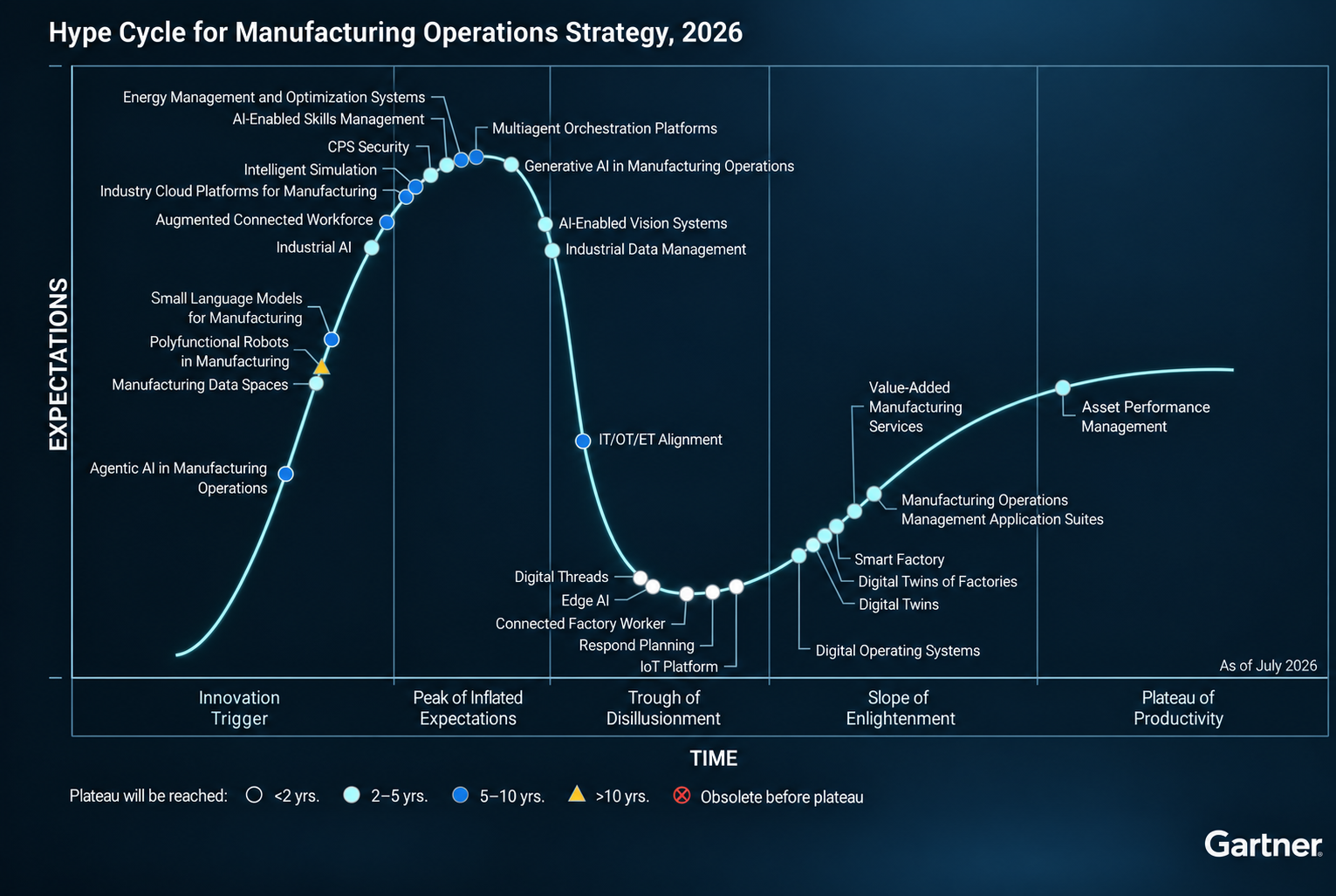
Manufacturing is FLOWBOX’s main market, and three of this year’s reports directly address it: manufacturing operations strategy, process manufacturing (chemicals, glass, ceramics, paper and food), and discrete manufacturing (mechanical engineering, automotive and electronics).
The process manufacturing report contains a statement that FLOWBOX considers the most important finding across all eight reports: pressure from energy prices is shifting energy technologies from reporting to operational control. The era of simply measuring and recording consumption is ending, and an era in which software automatically manages it is beginning.
In the same report, Gartner criticizes part of the market, saying that some vendors “offer only reporting, not actual optimization.”
Other findings from the manufacturing reports:
- Only 48% of manufacturing companies consider themselves prepared for what lies ahead.
- The most common barrier to savings is not a lack of technology, but a lack of data: according to Gartner, most facilities do not measure consumption at the level of individual production halls, lines and machines, leaving them without the data needed to optimize.
- Deploying industrial artificial intelligence has reduced machine failures by up to 67% (the example of Tata Steel Nederland).
“Most Czech industrial companies still manage energy by having someone enter the figures into Excel once a month. That was sufficient when energy was cheap and predictable. Today, it is one of the main risks facing a business,” adds Pavel Jiránek.
FLOWBOX’s industrial customers include ceramics manufacturer LASSELSBERGER (RAKO), with five plants, as well as AGC, HAUK, ASSA ABLOY, food industry manufacturer Viscofan, Valeo and Bühler.
Microgrids: Local Energy Systems Moving Toward Mainstream Adoption
In three other reports—covering energy grids, smart cities and data centers—FLOWBOX is listed in a different category: microgrids. These are local energy systems that combine on-site electricity generation, battery storage and consumption, and can operate independently of the main grid when necessary.
Interestingly, Gartner considers this category more mature than energy management software. While analysts estimate that the latter is five to ten years away from mainstream adoption, they put microgrids at two to five years and place them in a phase in which the market is already purchasing the technology in practice.
In its report on energy grids, Gartner explicitly describes the target form of Europe’s energy system as a “grid of microgrids,” adding that businesses and energy providers that postpone this transformation will only accumulate technical debt.
A Czech example is Zruč nad Sázavou, with five photovoltaic installations, battery storage and energy sharing between municipal buildings. Examples from the building portfolio include Volvo Group Czech Republic, the Chodov, Zličín and Černý Most shopping centers, and cooperation with BUILDSYS on battery storage management.
Electricity Availability Is Becoming a Constraint on AI Growth
The most surprising finding in this year’s reports concerns artificial intelligence rather than energy itself. In its data center report, Gartner writes:
“Through 2031, grid power availability will remain the primary constraint on data center expansion and will limit AI infrastructure growth despite sustained demand.”
In other words, the constraint is electricity—not a shortage of chips, funding or demand.
The reason is a simple mismatch in timelines, quantified by Gartner: building a data center takes 18 to 24 months. Reinforcing the electricity grid that will power it takes five to ten years. According to the International Energy Agency, annual grid investment would need to increase by half by 2030 to meet demand. Meanwhile, data centers are expected to account for half of all growth in US electricity consumption by 2030.
The grid will not catch up with this jump. Solutions are therefore shifting to the customer side: on-site generation, batteries and active demand management. These are precisely the areas in which FLOWBOX appears in this year’s reports.
More Figures Putting Energy Management in Context
- According to Gartner, only 22% of companies have so far seen significant benefits from adopting generative AI. Already, 54% require a demonstrable return before investing more in AI.
- The average building wastes 30% of its energy by lighting, heating and cooling spaces when no one is there. (A figure from the US ENERGY STAR program, cited by Gartner.)
- Cooling typically consumes 40% of all electricity used by a data center.
- In 2024, electricity for a medium-sized Czech industrial consumer cost roughly three times as much as in 2019: approximately €0.17 per kilowatt-hour, compared with €0.06. Although prices have fallen from their crisis peak, they are not returning to their previous level. (Eurostat)
- According to the International Energy Agency, Czechia is one of the European Union’s most energy-intensive countries because of the high share of industry in its economy. The agency’s model projects that in 2030, its energy consumption will be around 10% above the level required to meet its own energy savings target.

Terminology and Methodology
Exact terminology. In its reports, Gartner refers to the listed companies as “Sample Vendors.” FLOWBOX is listed in the “Energy Management and Optimization Systems (EMOS)” category in five reports and in the “Microgrids” category in three reports.
Source reports (all published in June and July 2026):
Hype Cycle phases. This year, the EMOS category is at the “Peak of Inflated Expectations,” with an estimated five to ten years to mainstream adoption. The Microgrids category is “Climbing the Slope,” with “early mainstream” maturity and an estimated two to five years. The first phase means that a category is attracting considerable attention and expectations are running ahead of reality. The second means that the initial wave of enthusiasm and subsequent disillusionment are behind it, and the market is beginning to buy the technology as a matter of course.
Gartner Disclaimer and Trademarks
Gartner does not endorse any vendor, product or service depicted in its research publications, and does not advise technology users to select only those vendors with the highest ratings or other designation. Gartner research publications consist of the opinions of Gartner’s research organization and should not be construed as statements of fact. Gartner disclaims all warranties, expressed or implied, with respect to this research, including any warranties of merchantability or fitness for a particular purpose.
GARTNER and HYPE CYCLE are registered trademarks and service marks of Gartner, Inc. and/or its affiliates in the U.S. and internationally.