

Starting on 1 January 2027, the way industrial facilities pay for electricity distribution in the Czech Republic will change. The reform affects approximately 25,000 companies connected to High Voltage (HV) and Extra High Voltage (EHV) networks, which includes most medium-sized and large industrial operations.
From 2027 onward, a single 15-minute interval may determine electricity distribution costs for an entire month. For some industrial businesses, this could represent hundreds of thousands of Czech crowns per year.
The reason for the change is to encourage companies to optimize (flatten) their load profiles, thereby reducing the risk of instability in the transmission system. At the same time, reducing quarter-hour demand peaks is expected to free up capacity within the grid, enabling more renewable generation assets and battery energy storage systems to be connected and approved.
What Changes on 1 January 2027
The new tariff structure introduces a two-component capacity charge for customers connected to EHV and HV networks.
Each month, customers will pay for:
- Reserved Capacity – the capacity reserved with the distribution system operator.
- Maximum 15-Minute Demand – the highest measured quarter-hour demand during the month.
Until now, customers did not pay a separate charge for reserved capacity itself. This is the primary change introduced by the reform.
Two tariff models have been proposed:
- T1 – higher weighting on reserved capacity, lower weighting on maximum demand.
- T2 – higher weighting on maximum demand, lower weighting on reserved capacity.
How the tariff is selected
At the end of each month, the distribution system operator calculates the cost under both tariff models and invoices the lower amount. Customers do not choose the tariff in advance. The outcome depends entirely on how the facility behaves during that month. Compared to the current system, this introduces a cost component that can change every month, potentially creating challenges for budgeting, cost forecasting and product pricing.
Detailed information and the official calculator have been published by the Czech Energy Regulatory Office (ERÚ).
Who Will Be Affected
The reform applies to all connection points supplied at EHV and HV voltage levels, typically from 22 kV and above.
In practice, this includes:
- Manufacturing plants
- Processing facilities
- Refrigerated and frozen storage warehouses
- Food production plants
- Data centres
- Large logistics hubs
- Facilities operating their own substations
The reform does not currently apply to households or small businesses connected to the low-voltage network.
Why 15 Minutes Can Determine an Entire Month's Cost
The most important aspect of the new system is not the existence of two tariffs. The key issue is how demand is measured.
The Maximum Demand component (which plays a critical role in tariff T2) is not based on average consumption, cumulative usage or total energy consumption in kWh.
Instead, it is determined by one single 15-minute interval during the month — the interval with the highest instantaneous power demand.
This is known as the Quarter-Hour Maximum Demand (15-minute peak).
A significant portion of the monthly distribution charge under tariff T2 is calculated based on this single quarter-hour.
A facility may operate with stable and predictable demand for 30 days, yet if several large loads start simultaneously during one 15-minute period, the resulting peak can substantially increase the monthly distribution cost.
What Will It Cost (and How Much Could You Save)
Model Impact According to the ERÚ Calculator
For a typical HV-connected facility with:
- Reserved Capacity: 5.35 MW
- Demand Peaks: 4.2–4.6 MW
the ERÚ calculator produced the following results:
Previous Structure: Annual Distribution Cost CZK 16.8 million
New Structure (Automatic T1/T2 Selection): CZK 15.5 million
Difference—-CZK 1.4 million (-8%) - this saving is achieved without any active peak-demand management.
In this model, the facility operates close to the crossover point between tariffs T1 and T2. The quarter-hour maximum fluctuates between 4.22 MW and 4.57 MW, while the crossover point between the two tariffs is approximately 4.30 MW. A difference of only a few hundred kilowatts can therefore determine how distribution costs are calculated in a given month.
For HV customers within the ČEZ Distribuce service area, the crossover between T1 and T2 occurs when the maximum quarter-hour demand reaches approximately 80% of reserved capacity:
- Above 80% → T1
- Below 80% → T2
What Companies Can Do: Four Areas of Control
The new tariff structure effectively rewards facilities that can predict and actively manage their electricity demand.
This can be achieved through four key approaches:
1. Submetering and Detailed Measurement
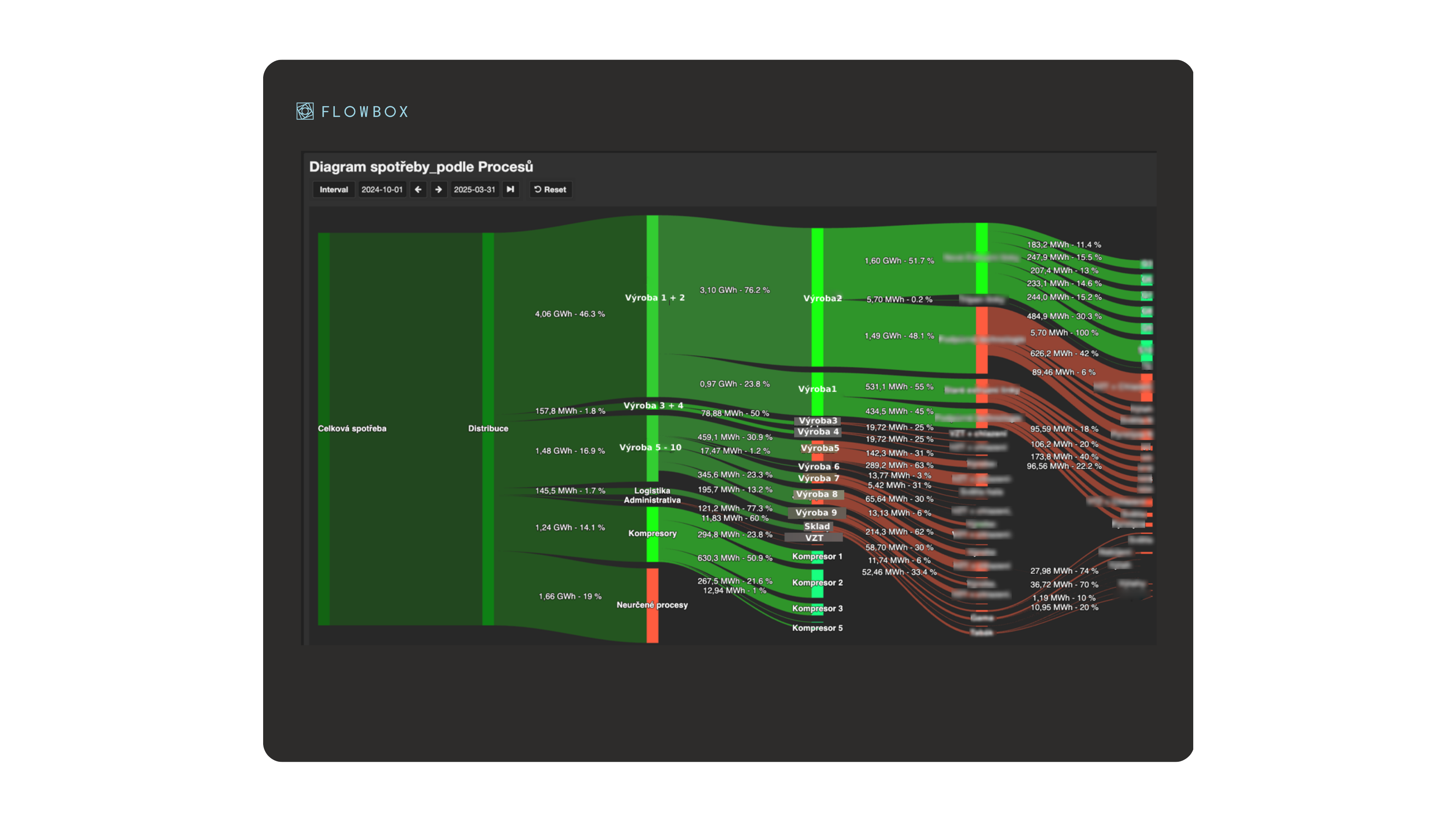
The main billing meter can tell you that a demand spike occurred. It cannot tell you what caused it. Without submetering data from individual production lines, halls or technological units, optimization is impossible. You merely collect historical data without understanding the root cause. Similarly, industrial parks and multi-tenant facilities need visibility into individual tenant consumption to identify who is responsible for demand peaks.
Reliable submetering infrastructure is therefore essential.
2. Quarter-Hour Peak Demand Control
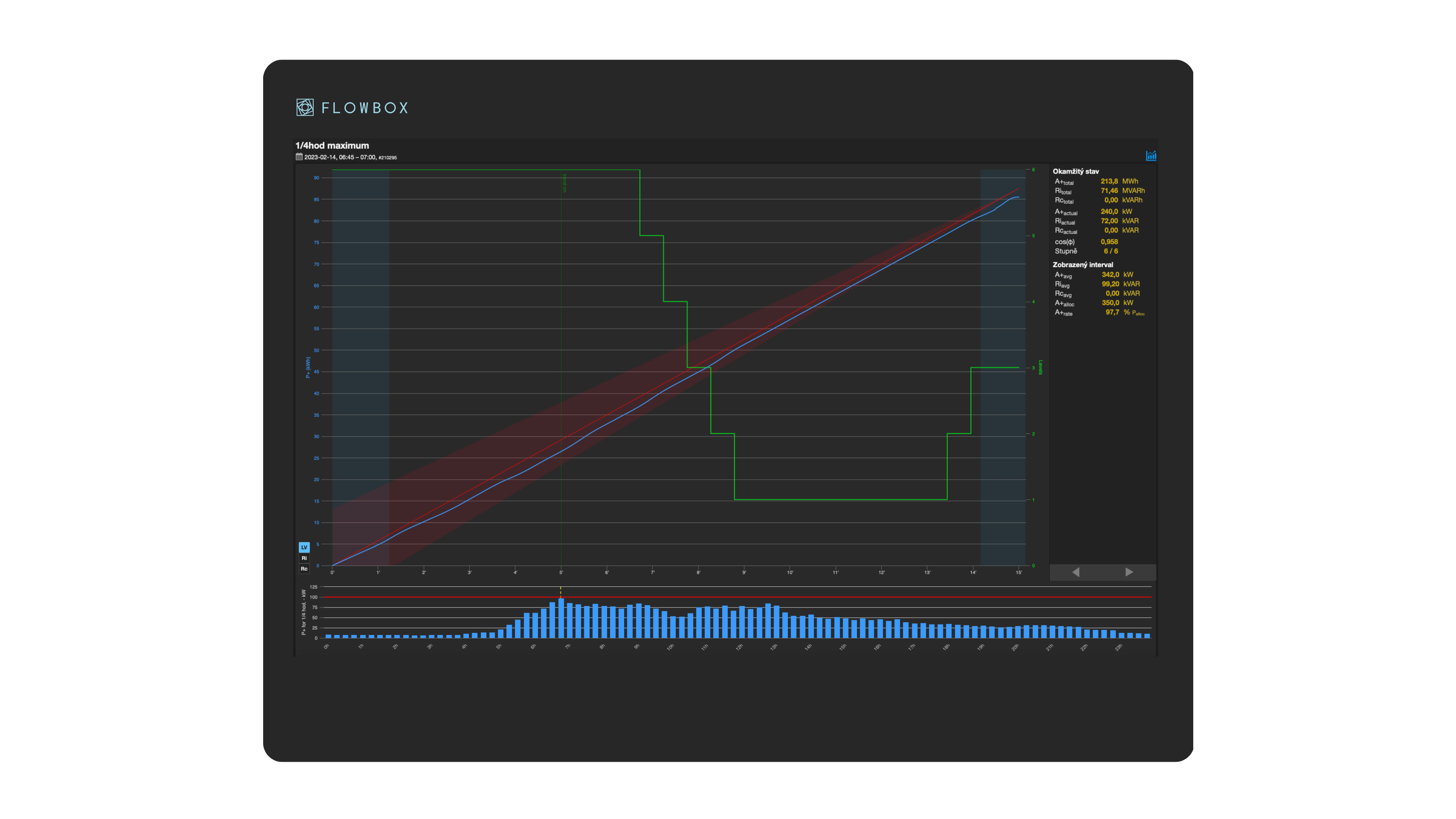
The system continuously monitors current consumption and repeatedly predicts expected demand during each 15-minute interval. If a threshold is likely to be exceeded, the system automatically adjusts loads by temporarily reducing consumption where it is operationally safe to do so:
- Lighting
- HVAC systems
- Electric boilers
- EV charging stations
- Other flexible loads
The goal is not to reduce total energy consumption but to avoid expensive demand peaks.
3. Planning High-Consumption Equipment
Most demand peaks are caused by startup events:
- Production line start-ups
- Compressor activation
- Cold storage pull-down cycles
A system that understands the production schedule and historical consumption patterns can plan energy-intensive processes so that multiple large loads do not start within the same 15-minute interval.
4. Battery Energy Storage Systems (BESS) for Peak Shaving
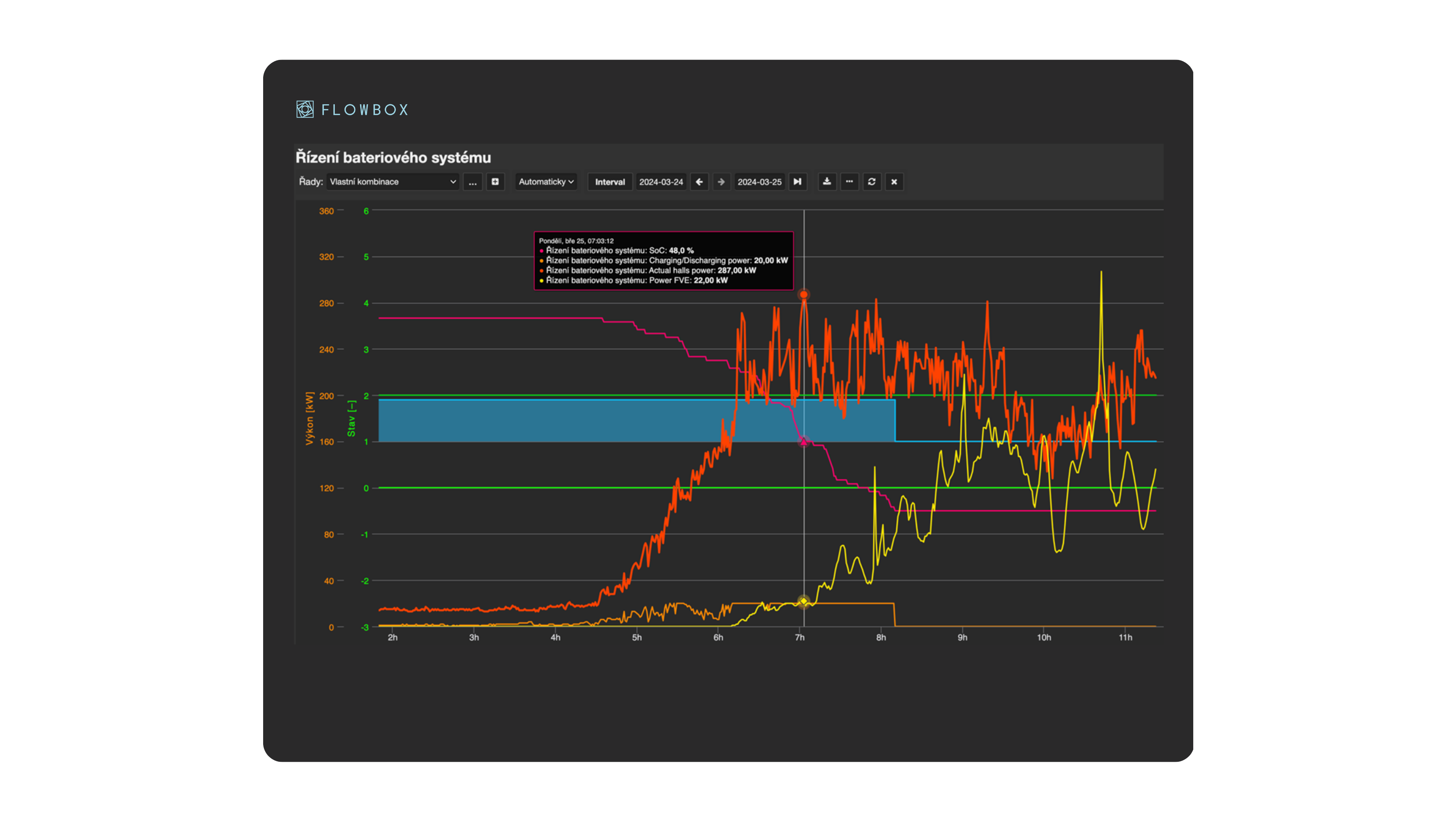
Some demand peaks simply cannot be postponed. Production cannot wait, and refrigeration systems must continue operating. In these situations, a Battery Energy Storage System (BESS) or another behind-the-meter energy source (such as a cogeneration unit) can be used to cover demand peaks using locally generated or stored electricity.
In this role, BESS is not primarily about energy savings. Its purpose is to flatten the load profile. The business case becomes significantly stronger under the new tariff structure because, under tariff T2, maximum demand carries approximately ten times more weight than reserved capacity.
To provide effective peak shaving, the battery system must be able to:
- Automatically start discharging when a peak is expected
- Deliver the required power output
- Recharge outside peak periods so that energy remains available when needed
How FLOWBOX EMOS Helps
FLOWBOX EMOS (Energy Management Optimization System) integrates all four approaches into a single platform. Specifically, it provides:
Real-Time Quarter-Hour Peak Control - The system continuously predicts electricity consumption for each 15-minute interval and automatically intervenes whenever a threshold is at risk of being exceeded.
Predictive Algorithm-Based Control - Integration with production schedules enables automated execution of control strategies and coordinated equipment start-ups based on forecasted demand.
BESS Integration and Control - Battery systems become an integrated part of the overall quarter-hour demand management strategy.
Advanced Data Analytics - The platform automatically breaks down consumption by: facilities, production lines, technologies and processes. It identifies recurring patterns, simultaneous load events and root causes of unusually high peaks.
Reporting for CFOs and Energy Managers - The system evaluates:
- T1 vs. T2 tariff impacts
- Optimal reserved capacity levels
- Expected effects on future electricity bills
The key advantage is not any individual feature but the fact that the system operates autonomously in real time, using live data and predictive analytics. Operators do not need to manually monitor quarter-hour demand charts or intervene themselves.
Four Steps to Prepare for 2027
The tariff reform cannot be avoided.
However, companies can use it as an opportunity to reduce overall electricity costs by smoothing their load profiles.
The preparation process is broadly similar across industrial facilities.
Step 1 – Establish Your Baseline
Without data, it is impossible to make informed decisions.
The first question is:
How much will the reform cost your business?
Actions:
- Calculate the expected impact using the ERÚ tariff calculator.
- Obtain 15-minute interval consumption data from your distribution system operator covering the last 12 months.
- Identify the highest quarter-hour demand in each month.
These values represent your current peak-demand profile.
Step 2 – Identify the Sources of Demand Peaks
Your main billing meter can tell you that a peak occurred.
It cannot tell you what caused it.
Actions:
- Determine whether you have submetering for production lines, halls and technological units.
- If not, implementing a submetering infrastructure should be your first project phase.
- Identify recurring timing patterns and simultaneous operation of large loads.
A typical submetering deployment project takes between 1 and 3 months.
Step 3 – Select Technical Measures
There are four primary tools available:
- Quarter-hour demand control
- Load scheduling
- Battery storage (BESS)
- Submetering
For most medium-sized industrial facilities, the best results come from combining these approaches.
The greatest savings are achieved when they operate together as a coordinated system.
Step 4 – Create an Implementation Plan
The first invoice under the new tariff structure will arrive in February or March 2027.
Any peak demand event that occurs in January 2027 cannot be corrected retrospectively.
Typical project timelines are:
PhaseDurationSubmetering infrastructure deployment1–3 monthsAudit and selection of control system supplier2–3 monthsControl system deployment (pilot to full operation)3–6 monthsBESS delivery and installation6–9 months
Myths
Myth 1: A Photovoltaic Power Plant Is Enough for Peak Shaving
Due to the variability of solar generation, photovoltaic systems are not a reliable solution for peak-demand reduction on their own.
In many industrial facilities, demand peaks occur during morning hours when solar production is still low or unavailable.
Myth 2: Peak Management Can Be Done Manually
In practice, it cannot.
Manually evaluating quarter-hour demand and reacting within the same interval is not realistic.
An autonomous energy management system is required.
Myth 3: Diesel Generators Are Suitable for Quarter-Hour Demand Control
Diesel generators are generally unsuitable for this application.
Startup times are often measured in minutes, making them too slow for many demand-control scenarios.
They are also environmentally unfriendly and economically inefficient compared to modern alternatives.
Myth 4: Battery Storage Is Only for Large Enterprises
This is no longer true.
Battery storage prices have fallen by approximately 50% over the last three years.
Furthermore, peak shaving does not require a battery capable of supplying an entire facility.
Example
Assume: Your peak demand reaches 600 kW. Your target quarter-hour maximum is 450 kW. You need to reduce peak demand by: 150 kW
If the demand peak above this threshold typically lasts one hour per day, the required battery parameters would be approximately: Power Rating around 150 kW, realistically 165–180 kW to account for losses and ageing. Energy Capacity around 150 kWh of usable energy, approximately 180–200 kWh installed capacity when depth-of-discharge limits are considered.
Note: This is only a simplified example. Accurate sizing requires analysis of your quarter-hour consumption profile, ideally covering an entire year to account for seasonal effects.
Conclusion
Companies that already operate energy management systems are likely to be in a stronger position after the reform than before.
Some may even benefit financially through:
- Optimization of reserved capacity
- Active peak-demand management
- Monetization of flexibility in ancillary service markets
Companies without energy management capabilities will effectively pay for the fact that, although their operations may be efficient most of the month, a single unfortunate combination of loads can create one expensive quarter-hour demand peak.
Let's Discuss It Together
We help industrial facilities prepare for the new tariff structure in the Czech Republic.
After an initial 30-minute, no-obligation consultation, you will have a clear understanding of:
- Which measures FLOWBOX can help you implement
- The expected scope of cooperation
- A realistic project timeline and milestones
- How FLOWBOX works in practice through a live software demonstration
Related Resources
Czech Energy Regulatory Office (ERÚ) – Tariff Structure Innovation (official information and calculator)