

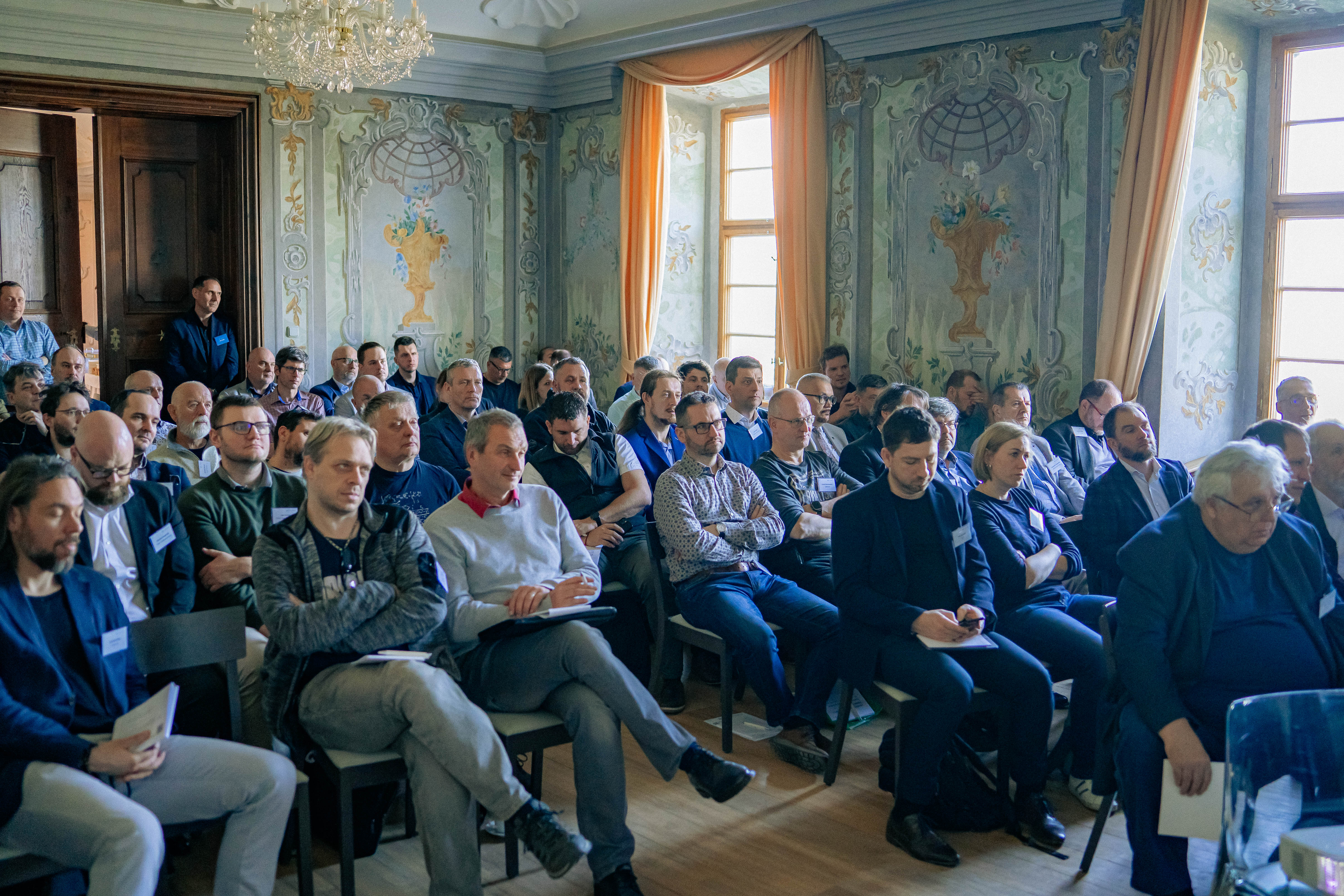
Over 100 energy managers, technical directors and business owners gathered on 19 March 2026 at Žďár nad Sázavou Castle for the second edition of FLOWBOX Energy Intelligence Forum. The day was defined by hands-on energy topics: microgrids, battery storage, community energy and energy management — no unnecessary theory.

The Castle as a Metaphor
We chose this venue deliberately - it tells a story on its own. A historic building where a modern approach to restoration and management quietly runs beneath the surface. Much like in the energy sector, where established businesses are finding their way towards data intelligence and automation. The host for the day was the castle's owner, Constantin Kinský, who set the tone for the entire forum in his opening remarks. And he gave it a clear frame: sustainability here is neither an ideology nor a marketing slogan. It is simply a practical necessity. Anyone who manages property knows that sustainable operations are not optional. They are a condition for survival. That pragmatic outlook — focus on running things well, not on image — resonated throughout everything the other speakers said that day.

Energy Management and ISO 50001: A Foundation You Cannot Ignore
Petr Gaman from FLOWBOX Energy opened with a topic that resonates across virtually every industrial company. Energy legislation is changing fast — LEX OZE III introduced, among other things, the ability to operate renewable sources up to 100 kW without a licence from the Energy Regulatory Office, enabled the formation of energy communities of up to 1,000 members, and from October 2025 legalised the operation of independently connected electricity storage devices. For companies with battery storage, the key date is 1 January 2027, when grid charges for reserved capacity will change.
Viktor Šaroch from TÜV Nord followed with a session on ISO 50001 certification — and immediately addressed the most common concern: the standard is not about paperwork, it is about building a system. Companies that implement it properly typically achieve energy cost savings of 5 to 20% in the first few years, without major capital investment. The key is the Energy Performance Indicator (EnPI) — each organisation defines it for itself and demonstrates improvement year on year. For businesses with average annual consumption above 23,611 MWh, certification is a legal requirement; for those above 2,778 MWh, it replaces the otherwise mandatory energy audit.
Battery Storage and Microgrids: From Theory to Real-World Operation
The afternoon session opened with Ivo Apfel from TESLA Energy, whose presentation went deeper than most — covering how to size battery storage correctly, what actually drives return on investment, and where companies most commonly go wrong in the design phase. Jan Denemark then demonstrated the FLOWBOX Microgrid module, making the point that effective microgrid management is not just about having the right technology — it is equally about the quality of the algorithms behind it, from simple decision trees to predictive models that respond to SPOT prices, weather forecasts and production schedules. The session also included a live demo of the FLOWBOX Microgrid ROI Simulator prototype.
"Data without context are just numbers. It is only when you know what is causing the peak — and what is making it unnecessarily expensive — that you start actually managing, rather than just watching."— Jan Denemark, FLOWBOX
Community Energy and LDS Operations: Real-World Examples That Work
Petr Gaman presented a working example of community energy in practice — the town of Rotava, which went through the entire process between 2023 and 2025, from initial concept through the construction of solar installations to the launch of energy sharing. Photovoltaic panels on the roofs of the primary school (46.8 kWp), the municipal office (49.5 kWp) and the water treatment plant (24.75 kWp) now supply shared solar electricity to the wastewater treatment plant, a care home for the elderly, the kindergarten and the fire station. The expected return on investment is 3 to 4 years.
Lukáš Pongrácz from Východočeská energie walked attendees through the day-to-day reality of operating a local distribution network. Východočeská energie currently operates 24 local distribution networks with more than 3,500 connection points, spanning residential, commercial and industrial projects.
Jan Denemark closed the session with an overview of the Energy Data Intelligence module within FLOWBOX EMOS. The system analyses electricity, heat, gas and water consumption and automatically identifies inefficiencies — idle consumption, dynamic anomalies, over-reserved quarter-hour demand peaks and unfavourable purchasing schemes. The output is not just a dashboard: every inefficiency is quantified in financial and CO₂ terms, so the energy manager knows exactly where to start.
The People Behind the Day
- Jan Denemark from FLOWBOX
- Constantin Kinský
- Ivo Apfel from Tesla Energy Group
- Viktor Šaroch from TÜV Nord
- Petr Gaman from FLOWBOX Energy
- Lukáš Pongrácz from Východočeská energie
- Miroslav Zapletal from FLOWBOX

What We Take Away
The second edition confirmed that energy management is no longer a topic reserved for engineers and energy specialists. Senior management was in the room — and came with concrete challenges to solve.
We are particularly pleased that the forum brought attendees together with each other. Sharing real operational experience — what works, what does not, and why — has a value that no presentation can replace on its own. And that is precisely why the forum does not end when people leave the conference hall.
Thank you to all our speakers, to Mr Kinský and his team at the castle, and to everyone who made the journey. See you at the third edition!
